
There's an assumption that anyone with a YouTube channel is quietly making a fortune. I've got another YouTube channel that's actually monetised, been through the Partner Program properly, and it earns me about enough for a GoPro battery a month. Meanwhile the KK costs three figures an hour to fly before I've filmed a thing. YouTube has just doubled the watch hours you need to get monetised in the first place, so this seemed like a good moment to show you some numbers, and to answer something I got accused of a few weeks back.
The bill
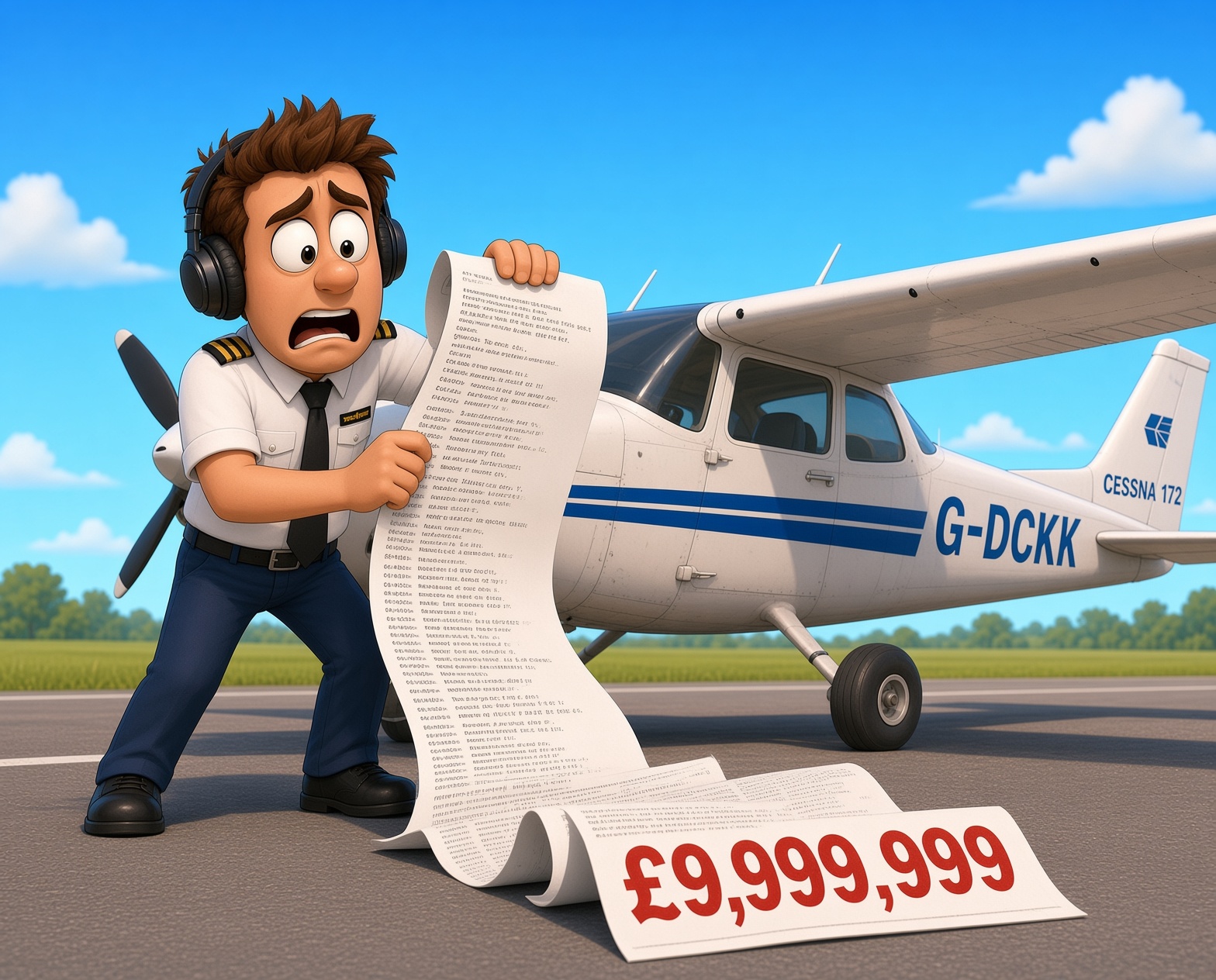 Every aviation video you've ever watched has an invoice attached to it.
Not a metaphorical one. An actual invoice, or actual money. Aircraft cost money. lots of it. KK runs to three figures an hour. Then there's a monthly standing charge, also three figures, which arrives whether I fly or not - we still have to pay to keep her safeyl on the ground. Then there is the fifty hour checks. the 100 hour, and then the annual, which can be four figures on its own, with a few extra zeros on the end if something 'interesting' turns up. And then, because apparently I've not spent enough, there's the airfield burger. Extortionate. Delicious. Juicy. Expensive.
If you work an hourly rate down to the minute it gets uncomfortable. Even more so if you then add in the time taken to process and edit footage. I dont have an editor. I am not looking for one. everything you see is what I do. Every taxi shot, every landing, every bit of scenery going past the window has a price on it, and that price is the same whether the video does well or whether nobody watches it at all.
The flying came first. The YouTube channel came second. I learnnt to fly, and then I bought into a share of KK because I wanted to fly, not because I wanted something to film. I was going to say I would still be flying if YouTube didn't exist, but that would be a lie, as I woudn't have started flying if I hadn't see other YouTubers going through the journey.
But it does mean the raw material is expensive and there isn't much of it. A gaming channel that needs more footage films some more tonight. If I need more flying footage I need time off, an aeroplane that's available, weather that co-operates, daylight, and the money for another hour. Miss the oppitunity and you're not reshooting it this afternoon, You are waiting for the next decent flying day
Eight thousand hours of watch time is a big ask for anybody. Ask it of us and every minute of the source material has a fuel bill attached.
So why bother
Because the money was never the point.
Whiskey Alpha Pilot doesn't earn anything. It never has. The other channel I mentioned is a business related channel, nothing to do with aviation, and that's the one that went through the YouTube Partner Program, and it was a struggle for other reasons.
What monetisation actually buys a small creator isn't income, it's a credential. Its a mark that at least sometinh you are doing is working. It's the thing that gets you taken seriously enough to be offered opportunities in the first place. The money itself is always going to be a rounding error against a fuel bill. Nobody says this out loud often enough, and I think the assumption that we're all making 1000s on YouTube does real damage to people deciding whether to bother starting.
"You need a CPL for that"
A while back, on a Facebook group, somebody with a fresh PPL was offering their services flying other people's aircraft for maintenance runs and positioning. I pointed out that if money was changing hands, they might want to check whether their licence covered it.
Somebody else then turned round and pointed the same accusation at me. "You fly and post videoes therefore you are making money. So YOU should have a hold a CPL." I don't. but then I dont get paid to fly.
I'd looked this up long before anyone raised it, because it's an obvious question to ask yourself the first time you pulbish a flying video. I'll also say that I know the CAA watch my videos, and they've had a good while to mention it if they thought there was a problem. That's not evidence and I wouldn't build a case on it. But if you want the actual facts, here they are.
The relevant bit is FCL.205.A, which sets out what a PPL(A) actually lets you do:
The privileges of the holders of a PPL(A) are to act without remuneration as PIC or co-pilots of aeroplanes or TMGs engaged in non-commercial operations and to exercise all privileges of holders of an LAPL(A).
Two separate conditions in and they're doing different jobs.
The first is about the pilot. Am I being paid to act as pilot in command? No. Nobody pays me to fly. I pay to fly, which I've just spent several paragraphs demonstrating in some detail.
The second is about the flight, and "non-commercial operation" is defined elsewhere, in Article 2 of the Air Operations Regulation:
"commercial operation" shall mean any operation of an aircraft, in return for remuneration or other valuable consideration, which is available to the public or, when not made available to the public, which is performed under a contract between an operator and a customer, where the latter has no control over the operator.
So: is the aeroplane being operated in return for payment? Is it available to the public? Is there a contract with a customer? For a Sunday trip to Duxford with Caz and a couple of GoPros, the answers are no, no and no. Nobody bought a seat. Nobody hired the aircraft. There's no customer anywhere in the arrangement. What exists afterwards is a video, which is a different thing entirely from the flight.
The ferry flights I originally commented on look rather different when you hold them up against the same two tests. Somebody's paying for an aeroplane to be moved. There's an arrangement between the person who wants it moved and the person moving it. And the pilot is being paid for the act of flying. That's the situation the rule is actually aimed at.
There's a carve out in paragraph (b), by the way, and it's narrow. A PPL holder with instructor or examiner privileges can be paid for giving instruction toward a LAPL or PPL, and for running skill tests and proficiency checks. That's it. Nothing in there about cameras.
If you're unsure about your own situation, ask the CAA or an aviation lawyer. Don't ask a bloke on the internet, including this one.
Forget 45 Hours, 8000 Hours needed
Pilots need a minimum of 45 hours in the air to obtain a PPL. YouTube is soon going to be asking for 8000 hours to join the YouTubr Partner Progrm, up from the 4000 hours current requirement.
When I first heard about the new requirements, it I posted in a group saying that was it, I was done. 8000 hours is a massive amount of watchtime for a channel that might get 100 views on a good day, and 853 people liked that post and 56 left a comment, most of them saying the same thing. Yeah. Us too. What's the point?
That's a lot of tired people all agreeing at once, and it took me a couple of days to work out that I'd made a bad decision quickly rather than a good decision slowly.
You have to Land at some point
You can't give up on a landing. as they say landings are mandatory, it's the take offs that are optional. But if you are coming in for a landing and you are high, fast and unstable, you don't press on and hope it comes good in the last fifty feet. You go around. Climb away, work out where you actually are, and have another go. Nobody in the circuit thinks less of you for it.
So why not apply the same logic to my YouTube Channel? The goalposts have been moved, and there is nothing I can do about that, but the answer isn't to stop and give up. The answer is to make more interersting content, more often, and to make it better.
I'm not doing this for the money. There isn't any. I'm doing it because I love flying, I love taking to people about what I love, and because somewhere out there is somebody in their fifties looking up at an aeroplane and quietly assuming they've left it too late. You haven't. I started at fifty and I'm still learning.
If there's something you'd like me to cover, tell me in the comments on the video. It's the only way I find out what you actually want.


