
Five years ago today I flew an aeroplane on my own for the first time. One circuit of Elstree in a PA-28, fifteen minutes in the logbook, and a right seat so empty it was practically shouting. If your own first solo is somewhere ahead of you, this is the post I wish I'd read the night before mine.
Nobody tells you that you can see it coming and still not believe it. That's the first thing.
By June 2021 things had been building. The circuits were getting consistent, the landings were happening where landings are supposed to happen, and there was a feeling around the place that it was close. So when I turned up at Elstree on 11 June and found myself flying a checkout with Ivan, the school's examiner, I knew exactly what it might mean. Knowing and believing are different things.
We flew our circuits. Then, taxiing back in, Ivan turned to me and asked if I felt ready.
I said no.
"Good," he said. "You're going."
I've thought about that exchange a lot in five years. At the time it felt like being pushed off a cliff by a man with a clipboard. Now I understand it. If I'd said yes, breezy and confident, that would have been the worrying answer. The student who doesn't feel ready is the one still taking it seriously. He wasn't asking whether I could fly the circuit. He already knew that. He was checking I still had the right amount of fear.
Then the aeroplane stopped, the door opened, and Ivan climbed out.
There's a moment, and every pilot I've ever spoken to remembers their version of it, where you look across at where your instructor should be and there's just an empty seat. Months of someone sitting there, catching things, asking questions, writing notes in their little notepad, occasionally sighing. All Gone. The radio suddenly sounds louder. The checklist feels longer.
Surprises
Here's what surprised me most. The aeroplane is a different aeroplane. One adult fewer on board and a PA-28 doesn't just climb better, it climbs like it's had good news. And the lightness is a genuine shock, because everything now seems to happen faster. Top of climb is supposed to be a thousand feet, and you look down and you're nearly at 11, and still still climbing, wondering when that happened. The turning points arrive early too. Was that the sewage works, or have I just flown over the sewage works? Oh. That was the sewage works. Lets face it all sewage works look like sewage works from the air. And now you're scrambling for the next reference point in a circuit you've flown fifty times, except today it's running at a pace nobody flew with you to warn you about.
So your first solo circuit is also your first circuit in an aeroplane you've technically never flown alone. That's the moment you grit your teeth and fall back on the only thing you've actually got up there: the training. Fly the numbers. Do the checks. Trust that the hands know the job even while the brain is busy pointing out how quiet it is.
The tower, meanwhile, already knows. The school phones ahead, so by the time you line up, everyone on frequency knows there's a first solo in the circuit, and everyone quietly does their best to make it easy for you. No tight instructions, no surprises, just a small invisible conspiracy of people keeping the sky simple for the next fifteen minutes.
The world is watching
You think everyone's watching, and they are. But they're not watching for your mistakes. They're rooting for you, because every pilot has been exactly where you are. The instructor on the apron, the controller in the tower, even the airline crews sliding through the TMA that starts just 1,500 feet above your head. Do they glance down at the little aeroplane in the circuit and think been there, done that? Who knows. But somewhere up there, there might even be a kid pressed against a cabin window going, mummy, I want to fly that little plane down there. Every pilot started as somebody looking at an aeroplane and wanting in.
Not that you notice at the time, because the inside of your head is a rolling news channel. What have I forgotten? Can I actually do this? You glance right for reassurance and there's nobody there, just empty space and a seatbelt, and while you're processing that the runway has arrived and you're about to flare.
And then the strangest thing happens. Landing. You're not bouncing. You're not careering off down the runway. The aeroplane is rolling along the runway like it's done this before, and your next coherent thought is oh, brakes, I should probably do those. You slow, you turn off, and somewhere between the runway and the parking the grinning starts.
It doesn't stop. Grins, more grins, grins for days. There's video evidence of me jumping off the wing like a man twenty years younger, which my knees have never forgiven, and the grin in that footage could be seen from the downwind leg.
The school makes a big deal of the whole thing, and rightly so. They have an experienced photographer on site, and they stuff cameras inside the cabin too, possibly to make sure it's actually you flying the aircraft and not someone who snuck in the back and swapped seats. But it means the memories survive intact. For the next fifty years you can bore absolutely everyone with the story of your first solo, and even if you stop flying tomorrow, nobody can take it off you.
Even now, five years on, when I hear a tower clear someone for Exercise 14, I'm quietly rooting for whoever's in that aeroplane, because everyone on frequency knows exactly what that call means. Some schools cut your shirt tails off, an old tradition that mercifully seems to have stayed on the other side of the Atlantic. At Elstree it was handshakes, photographs and grins.
I was lucky enough to have Caz floating around the whole time, being fed tea and biscuits by Jack, because she was almost certainly more worried about the whole thing than I was. There's something about watching the person you love take an aeroplane up alone for the first time that no amount of "the examiner wouldn't send him if he wasn't ready" quite fixes.
Every pilot tells you the same thing: you'll never forget your first solo. It's true. The aircraft was recovered intact, not on the back of a truck, and I broke nothing apart from my solo virginity. The moment those wheels touched down, something changed that can never be taken away. You walk out to your aircraft an ab initio student. You walk back in as a student PILOT.
Are you ready?
If you're pre-solo and reading this, a few honest things from five years down the road. The nerves are normal and they don't mean you're not ready. Your instructor will not send you up hoping for the best. By the time that door opens, going solo is the boring, predictable next step, even if your stomach disagrees. And if you don't feel ready, you're in good company. I said exactly that, out loud, to an examiner, and his answer was to get out of the aeroplane. Expect the aircraft to feel lighter and the circuit to feel quicker. It isn't your imagination and it isn't a fault. It's just physics removing your instructor.
When I landed and got a nice word from the tower, I felt I'd arrived. Because I had. And it turned out the landing wasn't the end of anything, it was the start of the rest of the journey: discovering exactly how much money one hobby can absorb, how many hundred dollar burgers one pilot can eat, and how many times I'd end up sitting in the Elstree café watching the rain stream down the window, thinking, I did that.
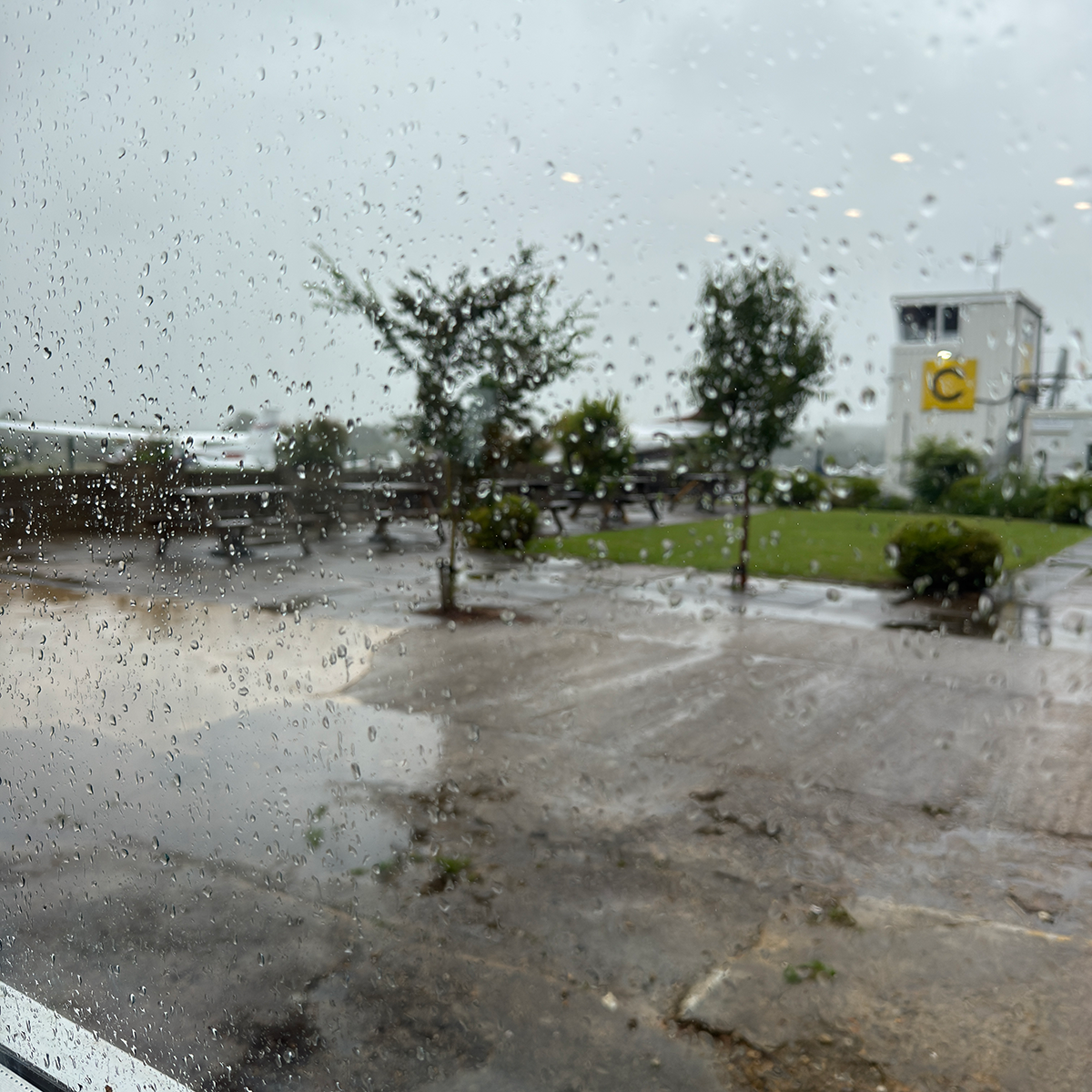
Which is where I am right now, five years to the day, tea in hand, watching the weather do its worst. The day we stop learning is the day we should stop flying. The first solo is just the day you start learning on your own.


