
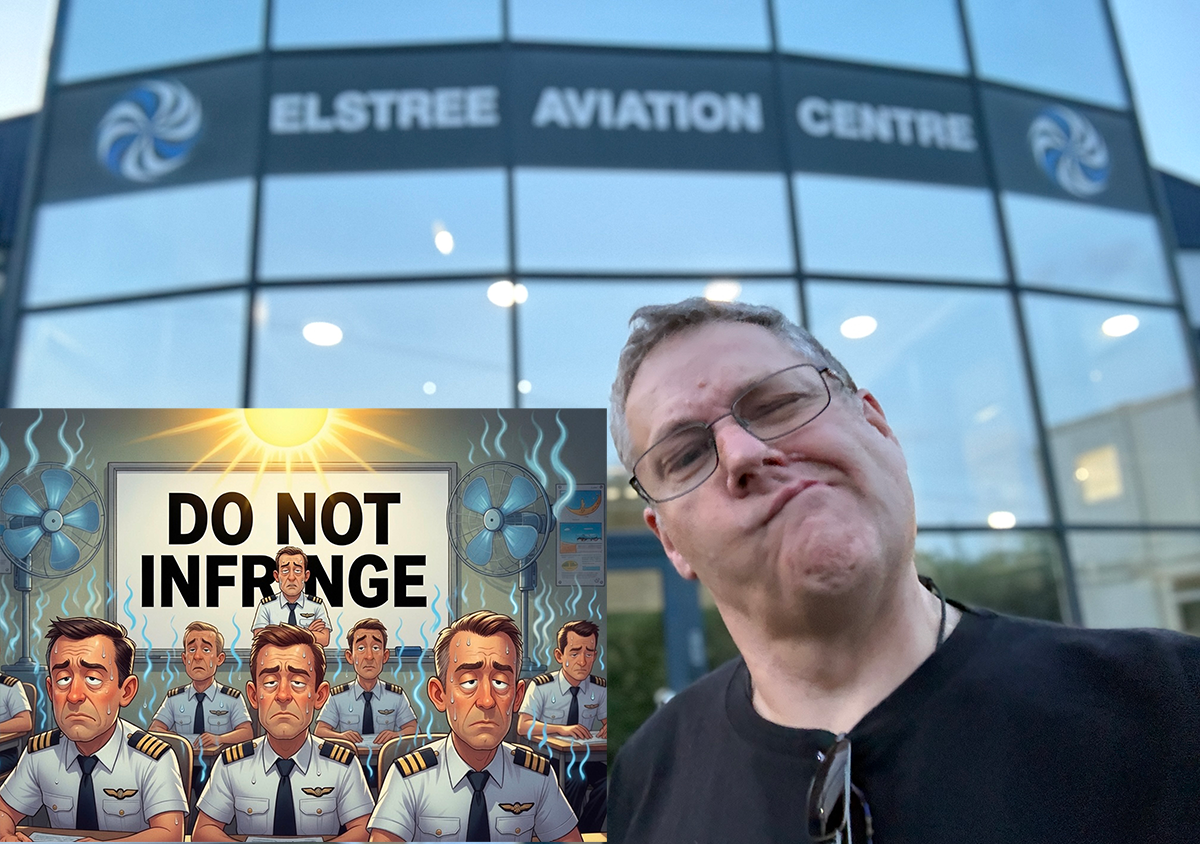
Last week I didn't fly because it was simply too hot. Thirty-three degrees the day before, density altitude doing unhelpful things, the kind of bumpy air Caz politely declines. So the plane sat in the sun and I stayed on the ground. And then I decided to I spent the evening in a portacabin with no air conditioning, and have a chat with the CAA.
Am I mad? the CAA? What did I do? Yes it is true, on the hottest May day ever recorded in this country, 35.1°C according to the Met Office, and I voluntarily spent two hours in a portacabin at Elstree with three of the scariest groups of people a learner pilot can meet.
The CAA, who can take your licence in a gentlemanly, government official, servant of the crown type way of course. NATS, who run the radar and who you're talking to on the day it all goes wrong. And the operators at Luton, who organised the evening, and whose busy controlled airspace sits right there on Elstree's doorstep waiting to be busted. Three different flavours of scary. The regulator, the controllers, and the airport that would really rather you didn't drift into its bit of sky. I think the airfield owner was also sitting behind me so I was cornered.
It was an Airspace Infringement Outreach seminar. The invite came through the flight school's mailing list rather than going out on socials, which felt like the right call. I wasn't entirely sure the general public was meant to be there. They just want to ban anything that doesn't fly them to Spain. So I sat near the back, took notes, and tried not to look like a man who runs a YouTube channel. Next time I will remember not to wear my WhiskeyAlphaPilot T-Shirt.
The numbers
Did you know there were 1,119 airspace infringements in the UK last year. That's the figure on the airspacesafety.com dashboard, which updates monthly, so it's the one I'm going with. The speaker quoted 1,135 on the night, close enough, probably a slightly different cut of the same data.
What got my attention wasn't the headline. It was the breakdown. Around 130 of those infringements happened on instructional flights. About one in seven. Factor in instructors who weren't actively teaching at the time and it creeps closer to one in five. These are the people who taught the rest of us. Instructors - the sky Gods who should know better. So what hope is there for the rest of us? And roughly one in ten infringing pilots had done it before within the previous two years.
Here's the part that should reframe how you read all of it. A bit of good news. They had cake….. Sorry wrong train of thought…. Airspace Infringements have fallen three years running. 1,384 in 2022, then 1,229, then 1,158, now 1,119. The trend is going the right way. Hold that thought, because it matters later.
No such thing as a little bust
This was the line of the night. If the limit is 3,500 feet, then 3,501 feet is a bust. There's no rounding, no "near enough," no benefit of the doubt. You're either in the airspace you're not supposed to be in, or you're not.
It sounds harsh until you understand what's sitting in that airspace. If you infringe, a controller is required to keep everyone else away from you by five miles or five thousand feet, sometimes reduced to three and three. That's not a British peculiarity, it's an ICAO separation standard. Now picture the gap between Stansted and London City, where the base of controlled airspace is 2,500 feet, City departures are climbing through 3,000, and Heathrow arrivals are coming down to 4,000. A GA pilot who drifts up to 2,700 feet is three hundred feet from an Embraer. That could spoil anyone's day.
They gave a real example. A microlight busts the London control zone near Bovingdon for about ten minutes. Heathrow departures stop for fifteen. Somewhere on the ground a transatlantic A330 is sitting there with its engines running, fully loaded, weight on the wheels, going nowhere. For scale, a planned twelve-minute flypast for Trooping the Colour can knock Heathrow's recovery out until the early evening. If twelve planned minutes cost an afternoon, what does an unplanned fifteen cost?
And then, quietly, the historical one. Aeromexico 498, Cerritos, 1986. A light aircraft strayed into controlled airspace, the controller was distracted by a separate intruder, and the airliner came down into a residential street. The speaker placed it in the seventies. It was the eighties. The point stands either way.
Swiss cheese
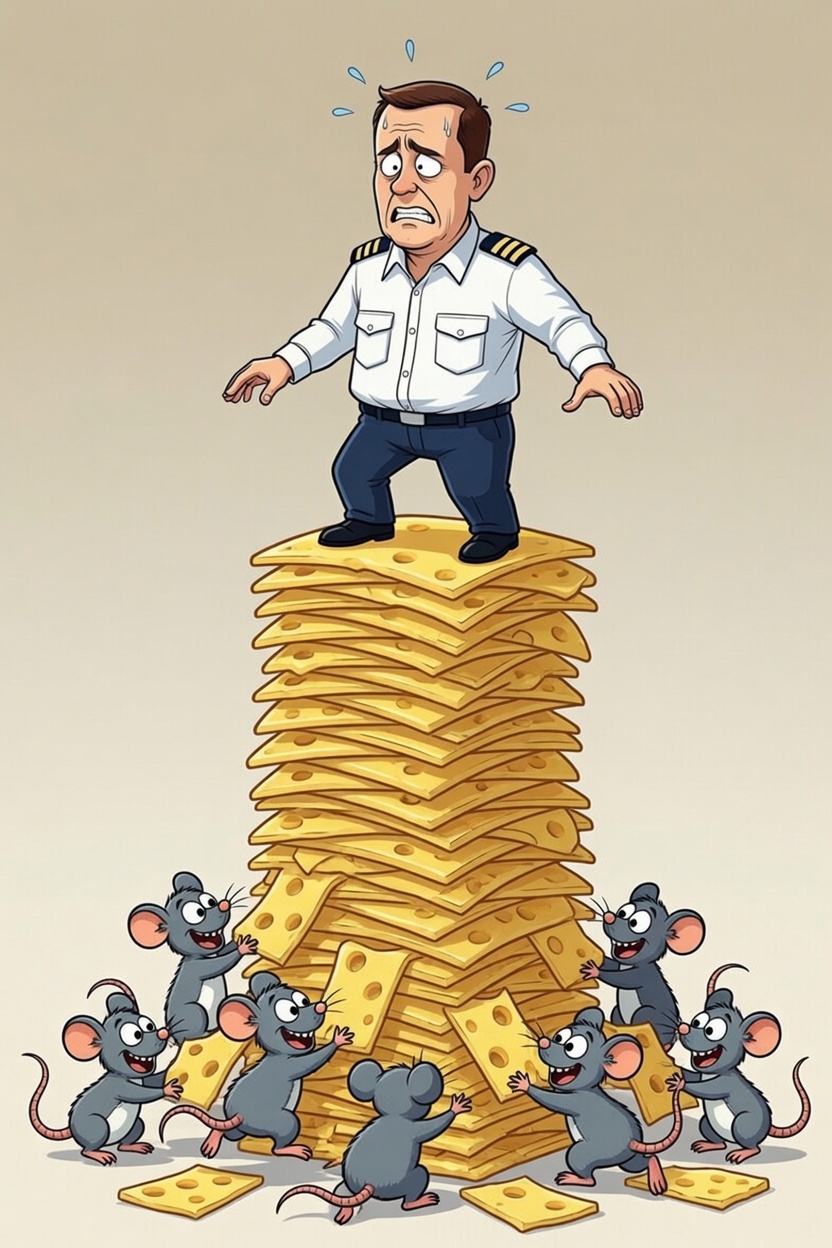
One of the speakers reached for the Swiss cheese model, and it finally made the CAA's "use everything" advice make sense.
Every safety layer has holes. The chart, NOTAMs, your moving map, a Listening Squawk, the transponder, the controller's tools, the controller's eyes, your eyes out of the window. None of them is perfect on its own. Infringements happen when the holes line up. Add more slices of cheese and you have a mega burger, or more layers of safety where it then gets harder for a clear path to open all the way through.
Here's where I landed on it though, and this is mine, not theirs. The layers haven't got worse over the years. We've got more willing to take them out ourselves. Plugging in an IFR waypoint when a visual one would do. Leaning on the moving map instead of calling for a Listening Squawk. Treating the transponder as optional. Skimming the chart rather than reading it. Each one is just the slightly easier option, and each one quietly thins a layer. The CAA calls it normalisation of deviance. The rest of us call it getting comfortable. It's 30 in a 30, then 32 just the once, then 32 every day, then 34, and then a kid runs into the road.
What actually happens to you
I'd assumed the CAA were mostly in the business of handing out punishments. They're not. Well they would say that. But every single bust gets investigated, no exceptions, and the decisions get published. Look at the 2025 numbers and the shape of it surprises you.
Back to the results. About one in ten cases (10.1%) were logged as "No AI": no airspace infringement, it didn't actually happen the way it was reported. Another chunk came back as "AI but no further action." The single biggest outcome, just under half of all decisions, was an advisory letter. Above that sits a ladder of training: an online tutorial and test, and the Airspace Infringement Awareness Course, which on its own accounted for nearly one in five.
At the very sharp end, seven provisional suspensions in the whole year. That's 0.7%. Not seven prosecutions, not seven licences torn up, seven cases where the CAA temporarily parked a licence while it worked out what to do. No licences were actually revoked in 2025 at all. The team's line on the night was that the cases that go that far are usually the ones where the pilot won't engage with the process, rather than the bust itself being uniquely awful. The enforcement team is nine people, all pilots themselves, single-engine, helicopter, commercial, a real mix. Not a faceless committee.
The question I came to ask
I put my hand up. Is the rise of the tablet, SkyDemon and the like, linked to the rise in busts?
The answer was better than the question. Busts are falling, not rising, three years running. The tools are helping. What worries them is what's happening underneath that falling number, pilots leaning on the screen at the expense of the skill the screen replaced. The number looks fine. The foundation might be quietly eroding.
I'm planning to test the official 'guidance', by the way. That experiment is taking longer than I thought as I am still wading through the 270 NOTAMs on the official list. Don't use SkyDemon as a source for NOTAMs as it's unofficial.
On the subject of Transponders
There's a rule, SERA.13001, that says if your transponder works, you use it, the whole flight, whatever airspace you're in. Some pilots still treat Mode C as something you flick on for the busy bits, or assume it's just there so Flightradar can track you.
Switching it off doesn't only hide you from the internet. It removes you from the controller's conflict tools, from collision alerting, from any chance of a defensive heads-up. Worse, controllers assume a non-transponding aircraft is staying below controlled airspace, and they route the airliners on that assumption. You haven't just removed your own slice of cheese. You've handed the controller a false picture. As the official guidance puts it, switching off Mode C if you fear you've infringed is "dangerous, illegal and very poor airmanship."
Which brings me, awkwardly, to my own aircraft. KK has had an encoder problem in the past. I didn't catch it. A controller did, during a routine altitude check, asked us to confirm the reading and suggested we get it looked at. It was out by around 200 feet, well outside the 125-foot tolerance the rules require. We replaced it. Nothing dramatic happened, no infringement, no Airprox, just a slice of the Swiss cheese that had quietly stopped working until someone on the ground noticed.
There's a simple check for it that most of us, me included, never do. Before you fly, wind the altimeter to 1013, note the height it shows, and compare it to your Mode C readout. They should agree within 125 feet. Mode C always reports against 1013 regardless of the QNH you've set, so it's the honest second opinion on whether your kit is telling the truth. If I'd done it, we'd have found KK's encoder a lot sooner.
Am I going to change?
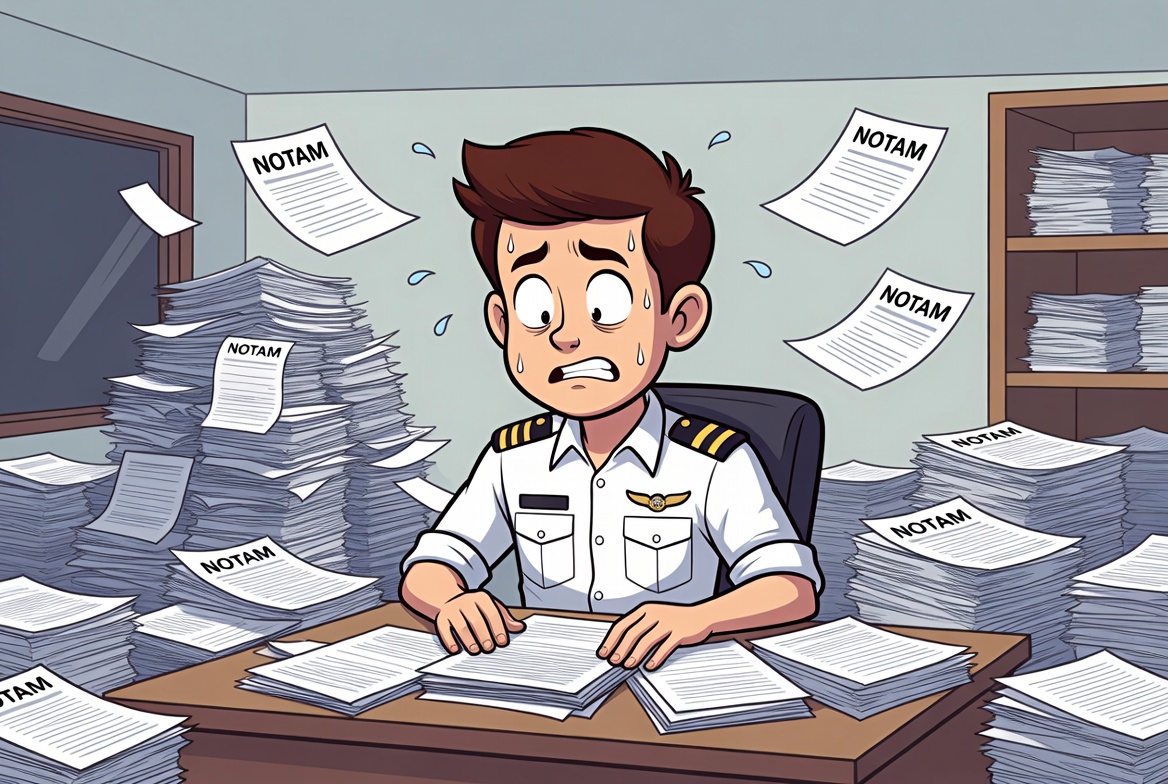
Yes. I think. I'll start with two things, mainly, because four would just be a list I'd never keep.
I'll start using visual waypoints in SkyDemon for VFR routes, not the IFR identifiers I'd lazily got into the habit of using. And that pre-flight 1013 cross-check between altimeter and transponder, every time, now that I know how cheap it is and how much it can catch. And I will look for the official NOTAM sources instead of relying on SkyDemon, once of course I have waded through the list of 270 of them that pop up on a flight from Elstree to Duxford. Yes 270. Hours of fun reading.
During the War….
There's always one. An unnamed individual wanted us all to know that back in the eighties they didn't need any of this. He was probably right that fewer infringements got recorded. He was probably wrong about why. UK GA fatal accident rates have come down a long way since then. More aircraft fell out of the sky in his golden age. No tablets, true. Safer, no.
Debrief
Lastly they spent a fair chunk of the evening on the value of debriefing. Every flight, they said. Don't let the lessons evaporate. At last a reason for having a camera in the cockpit. I debrief every flight normally in front of a group of armchair pilots who have more experience in MSFS than I do. But I get their point.
Was it worth going? Yes. If you get the opportunity then go. They might be scared, they might be watching (I hope so I need more subscribers), but they are trying to do a difficult and complex job and keep us all safe, I think. At least they had cake.
Wayne


