
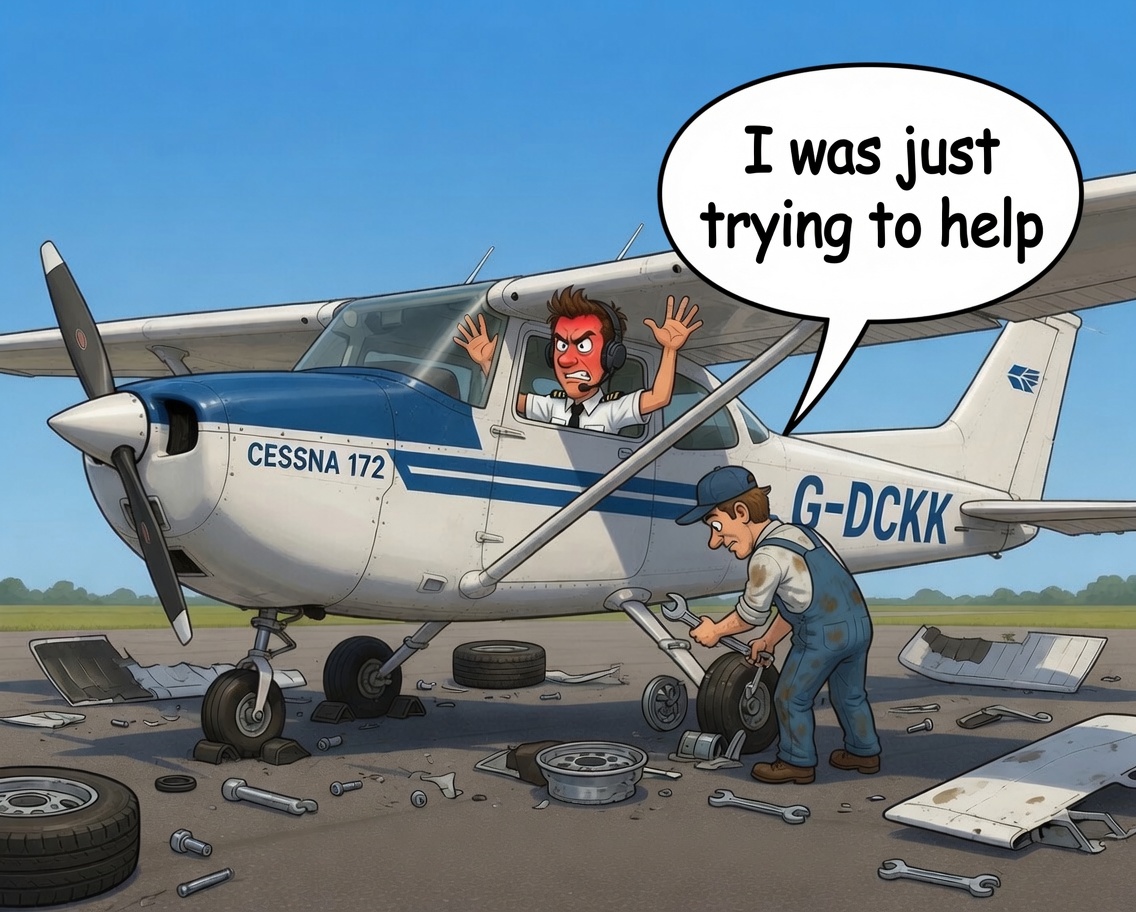
On the ground, please stay away from my aircraft.
We all know someone who just wants to help. The chap at your wingtip the moment you stop, full of goodwill, ready to save you a minute. And every so often that minute turns into a scraped wingtip, a torn covering, or a very long phone call to your engineer. So here's the question I've been chewing on. We are supposed to run a "sterile cockpit" in the air for a reason. Why does that bubble pop the second the wheels stop?
Yes I put "sterile cockpit" in quotes because if you follow my YouTube channel, you will know mine isn't very sterile. I talk, I muse, I get distracted by a nice aeroplane on the apron. It's only in the last 600 feet or so that I try to shut up and concentrate. So I'm not preaching a standard I keep. But even my half-hearted version has a moment where the talking stops, and all I'm asking is that the ground gets one too.
As a student there was one rule that was drummed into me. Assume every aircraft is live, that spinny bit at the front especially. You can't tell by looking that an aeroplane is safe. Wheels stopped and noise gone doesn't mean the mags are dead or the prop won't turn. The only person who knows is the pilot, still working through the checks that make it safe, and even if they think it's safe things can fail at any time.
We all know that anyone can offer advice, and the lovely thing is I can ignore it. I smile, I nod, I carry on, no harm done. I'm not being rude. I'm doing it my way, the process I can repeat and whose mistakes I can see. Words I can let pass.
A hand I can't. There's a world between a stranger telling me something and a stranger doing something. The second has already changed my aeroplane, or broken my flow, before I've had a say. And the flow matters as much as the metal. We've all got a sequence to complete, and any interruption knocks it sideways. A friendly word at the wrong moment isn't friendly, it's a checklist item missed. Missed, or I have to start again.
Oops, Sorry
So here are the greatest hits. The marshaller who isn't a marshaller, waving you confidently towards the pump, plenty of room, plenty of room, right up until the wingtip says otherwise. Their confidence, my wingtip, my repair bill. Then it stops being funny. A ladder shifted near the prop, because KK's a high wing and someone's decided to lend a hand to save me time, and it's a clipped leading edge or a ding in the prop.
Nobody argues with this bit. When it goes wrong, it's my name on the aeroplane, not the stranger's. He walks away. "He said I had clearance" has never once been a defence.
I'll let myself off before you do. I fly a humble fifth-share of a 1977 Cessna, not a strategic asset. But you know the popular image, the one where you approach a nuclear-armed aircraft uninvited and a very serious person with a big gun, and normally an american accent invites you to HALT!!. I'm borrowing the principle, not the firepower. I won't have you shot for wandering up to KK. I'd just quite like to shut down and finish my checks first. Honestly, nobody should walk up to any aircraft uninvited. It's asking for risk for no good reason.
The commercial pilots, the ones who do it for a living, almost never pull this. They know better. They know everyone's got a process to finish and that breaking someone's flow is its own small hazard, never mind the prop. No, the danger is the chap who's been flying the same aeroplane since roughly the Coronation - and he's probably not sure which one. He built his aircraft himself, in a potting shed, from a plan he's annotated in three colours of biro. He probably still flies on a brown, hand-stamped licence with the pounds, shillings and pence crossed out and the new money written in above. He grew up on linen and dope and a shelf of Airfix kits, all the same aircraft, because the mouldings were subtly different and he could tell. He regards anything more modern than a Dalton's dead reckoning computer as a worrying lapse in standards, and he still reads the Rules of the Air, 1929 edition, daily, for pleasure. He is wonderful, and he is absolutely going to wander up and lend a hand whether you asked or not. He always flies without a transponder as it is more authentic.
I say all this with love, because I'll be that man one day if I'm lucky (I don't have a potting shed, but I do like a good classic Biro). I'm still very much working things out, which is exactly why you won't catch me strolling up to anyone else's aircraft. I will wait until invited, and well away from the spinny thing. The qualification is caution, not a logbook. Forty years or four hours, the people who hang back are the ones who respect the risk.
So ask me. Ask, and it's all yours, the ladder, the guidance, the hand, because then I've still got command of it. Don't, and you haven't helped me. You've added a hazard to an aeroplane that isn't safe yet and a pilot who isn't finished.
We say it in the cockpit every time we hand over. Plain, unambiguous, so two people are never both reaching for the controls. One person in command, and right now, that's me.
My aircraft. I have control.


